
Managed Custom Software & AI

Build the software your business needs without one large upfront bill

D3FY designs, builds, hosts, monitors, and maintains custom business software through a predictable monthly engagement. Start with the work that matters most, get it into your team's hands, and improve it without hiring an internal software department.

  • Start with the highest-value workflow
  • Plan development around a monthly budget
  • Host and monitor the production system
  • Maintain and improve it over time
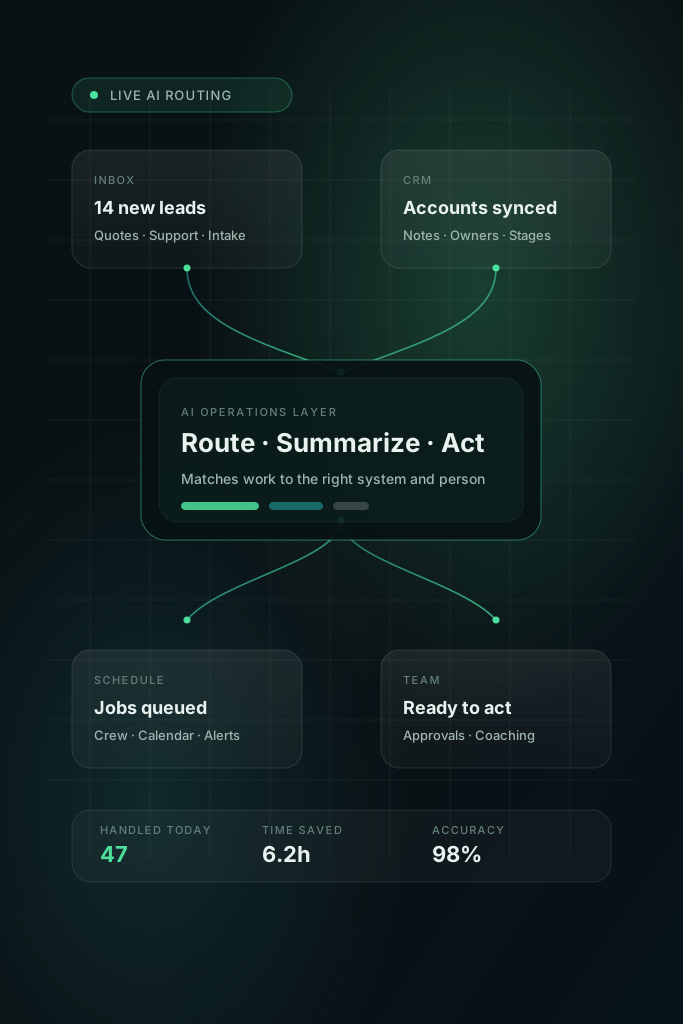
Diagram of AI software routing work across inbox, CRM, scheduling, and your team

Consult → Configure → Build → Train

A Practical Way to Build

Put useful software to work before you fund the whole roadmap

For qualified projects, we replace the traditional build-and-disappear engagement with an ongoing monthly relationship. The fee covers an agreed development plan and the operating responsibilities your software needs after release.

Modern tools can help generate code. They do not own your uptime, protect your data, investigate failed integrations, plan safe releases, or answer when the software your team depends on stops working. We do.

Discuss a managed build
  1. 01

    Build in useful increments

    Start with the smallest version that solves a real operational problem. We plan the next work around what your team learns instead of financing a large specification before anyone uses it.

  2. 02

    Run it like business infrastructure

    We configure hosting, releases, backups, security updates, error tracking, and service monitoring so the system has an operating plan—not just a launch date.

  3. 03

    Maintain and improve it

    The monthly engagement keeps one accountable technical team available to fix defects, maintain integrations, and improve the software as your operation changes.

Why D3FY

The difference is everything around the feature

A screen that works in a demo is only the beginning. We also set up the architecture and security monitoring most people miss when they try to build software themselves — the production details that make it dependable enough to become part of your business.

  • Workflows shaped around real roles, decisions, handoffs, and exceptions
  • Secure access and data boundaries designed before production
  • Monitoring for uptime, application errors, background jobs, and integrations
  • Backups, release checks, recovery planning, and documented ownership
  • Ongoing maintenance as browsers, APIs, dependencies, and business rules change

Is This The Right Fit

Know before you reach out

Not every business or workflow is ready for custom software or AI. Here is a plain read on where we're likely a good fit, where we're usually not the right call yet, and the kinds of problems that typically bring people to us.

Good fit for an engagement

  • You have a specific, recurring workflow that costs real time or introduces errors — not just general interest in "using AI."
  • The systems and data involved are things your team can describe and access, even if the current state is messy.
  • Someone on your team can own the process and adopt the resulting tool once it ships.
  • You're willing to start with the highest-value piece of the problem instead of a full platform rebuild on day one.

Usually not the right fit yet

  • A proven off-the-shelf tool already covers what you need — we'll tell you that instead of building something custom.
  • The process is still changing week to week and hasn't stabilized enough to automate yet.
  • No one internally will be available to own, review, or use the system after launch.
  • You need a guaranteed accuracy rate, fixed price, or fixed delivery date before any discovery work has happened.

Representative problems we're brought in to solve

  • Leads or inquiries sit unanswered for hours because no one owns first response.
  • The same customer question gets typed out by hand multiple times a day.
  • Data has to be re-entered across two or more systems that don't talk to each other.
  • Invoices, forms, or documents get processed by hand before anything can move forward.
  • A spreadsheet or shared inbox has become the unofficial system of record for something important.
  • Staff spend more time coordinating handoffs than doing the work itself.

How We Help

Three ways to turn operational friction into forward motion

Start with one costly workflow or bring us a broader operations problem. We will help determine whether to configure proven tools, build custom software, or manage the system for you over time.

01

Workflow & operations automation

Give your team time back by removing repetitive handoffs and keeping routine work moving.

Lead response, CRM & scheduling

Capture inquiries, enrich the record, route the opportunity, and offer the right next step without re-entering the same information.

Email routing & assisted drafting

Classify incoming messages, send them to the right owner, and prepare context-aware drafts for a person to review.

Document & invoice processing

Extract approved fields from documents, validate the result, and synchronize clean data with the systems your team already uses.
02

Custom business software & integrations

Build the operational software your business needs when disconnected tools and generic chatbots are not enough.

Support & sales assistants

Help staff answer questions using approved company knowledge, with source links and clear escalation paths.

Internal portals with AI assistance

Bring workflows, business data, documents, and guided actions into one purpose-built workspace.

Website search & lead qualification

Help visitors find useful answers, gather relevant context, and route qualified requests to the right person.

03

Managed software systems

Keep production automations dependable as tools, APIs, business rules, and security requirements change.

Maintenance & API monitoring

Monitor integrations, review failures, maintain prompts and model configurations, and test changes before release.

Hosting, uptime & security updates

Manage the deployed system, infrastructure updates, backups, and service expectations defined for your engagement.

Five Ways We Can Help

Consulting, configuration, integration, custom build, or managed support

These aren't marketing tiers — they're different kinds of work, priced and scoped differently. Most engagements combine more than one, and discovery determines which ones apply to your situation.

Consulting

We evaluate a process or tool decision and give you a written recommendation. No code ships at this stage — it's the discovery work that determines whether configuration, integration, or a custom build actually makes sense.

Configuration

We set up and tune an existing platform — a CRM, a form tool, an AI assistant platform — to fit your workflow, as a practical starting point when a proven tool already covers most of the need.

Integration

We connect systems that don't talk to each other today, syncing records and triggering actions so your team stops re-entering the same information by hand.

Custom build

We design and build software specific to your operation when no reasonable combination of existing tools covers the workflow, the data, and the review requirements involved.

Managed support

After launch, we monitor the system, maintain integrations and prompts, apply updates, and adjust the solution as your tools, APIs, or business rules change.

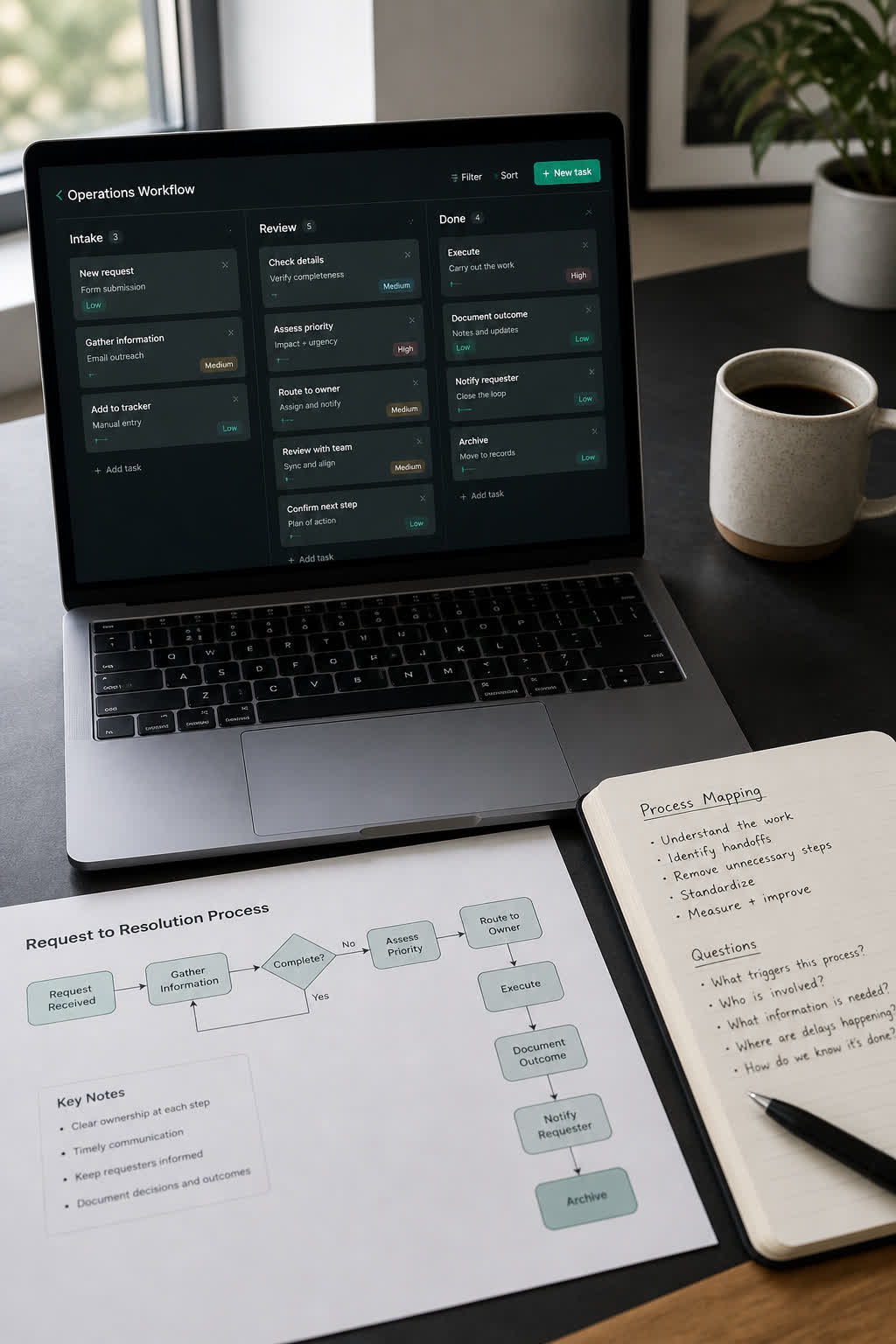
Laptop showing an operations workflow board next to a handwritten process map
01

Start with the operation. Choose the technology second.

Built Around Your Business

AI should fit the work—not force the work to fit AI

A useful solution has to respect the systems you already depend on, the information your team can trust, and the decisions that still need human judgment.

Connect what already works

Integrate with the software and data your operation uses instead of creating another isolated tool.

Keep responsibility clear

Define what the system may prepare or automate and where a person must review, approve, or intervene.

Design for adoption

Build around real users, document the workflow, and give your team the skills to operate it confidently.

How We Work

One engagement, from decision to adoption

You do not need to arrive with a technical specification. Bring us the operational problem; we will help determine the right path and make it concrete.

  1. 01

    Discover

    Find the work worth improving

    We map the process, bottlenecks, data, risks, and people involved before recommending software or AI.

  2. 02

    Design

    Choose the right level of technology

    We decide whether to configure a proven tool, connect systems, or build custom software around your operation.

  3. 03

    Build

    Deliver a working solution

    We prototype with real workflows, refine with your team, and turn the validated approach into dependable software.

  4. 04

    Adopt

    Give your team the skills to use it

    We document the system, train the people responsible for it, and establish a practical path for ongoing improvement.

Setting Expectations

What we can tell you before we've scoped anything

We would rather be precise about what's true today than promise a number we cannot back up.

Monthly plan & starting scope

Qualified projects can use a predictable monthly engagement instead of one large upfront development bill. Discovery defines the first useful release, included operating responsibilities, initial term, and realistic monthly fee.

Ownership & handoff

Ownership, source access, credentials, documentation, and who maintains what after launch are resolved during scoping and put in writing before development starts, not assumed at delivery.

One accountable team

The team building the software can also own its cloud infrastructure, monitoring, maintenance, release checks, and planned improvements—so production responsibility does not disappear at handoff.

What You Leave With

A working system and a team prepared to use it

Our job is not finished when a prototype looks impressive. The value is in a solution your business can operate, evaluate, and improve.

  • 01

    A prioritized opportunity map tied to business operations

  • 02

    A clear recommendation: configure, integrate, or build

  • 03

    Working software with review points and practical safeguards

  • 04

    Documentation and hands-on training for the people using it

  • 05

    A roadmap for measuring results and improving the system

  • 06

    An ownership and handoff plan — source access, credentials, and documentation — agreed during scoping

Security, Data & Human Review

Where automation ends and a person has to decide

These are the defaults we start from. Specific boundaries for your data and workflow are documented in scope before development starts — see our related guide on AI and small business data security.

  • We access only the systems and data required for the scoped work, using credentials and permissions your team controls.
  • Every automation has a defined boundary for what it may do unattended versus what requires a person to review or approve before it takes effect.
  • Handling requirements for sensitive or regulated data — financial, health, or personal information — are agreed during scoping, not assumed afterward.
  • Production access, backup responsibility, and the terms for revoking our access are defined in scope, not left implicit.

Common Questions

Before you reach out

Who owns the software once it's built?

We offer two paths. Most clients use a month-to-month licensing model while we build and maintain the software. If you want full IP ownership, we can structure that too—typically at a higher investment—and we settle ownership, source access, credentials, and documentation during scoping before development starts.

Can you build and maintain software for a monthly fee?

Yes—for projects that fit our managed model. We define the first useful release, the ongoing development capacity, and the operating responsibilities included in a predictable monthly fee. The amount and initial term depend on the systems, data, risk, and work involved, so we confirm them after discovery.

What if the right answer is not to build anything?

That happens. If a workflow doesn't justify custom software, or an off-the-shelf tool already solves it, we'll say so. Our AI readiness audit exists specifically to answer that question, with no obligation to move forward.

Do you need full access to our systems?

No. We scope access to what a specific engagement needs, and we document data handling and human-review boundaries before development starts.

What happens after the first release?

With a managed engagement, we continue operating the system: monitoring, maintenance, updates, integration support, and planned improvements. Ownership, source access, credentials, documentation, service expectations, and the exit or handoff path are agreed during scoping.

Start With the Bottleneck

Show us where the work slows down

We will help you assess the opportunity and decide whether the answer is a better tool, a connected workflow, or custom software built for the job.